3D printing
Best filament for functional homelab parts: PLA vs PETG vs ASA vs TPU
Choose PLA, PETG, ASA or TPU for rack brackets, Pi mounts, outdoor radio cases and feet. Compare maker heat data and four spool picks by job.
OUR PICKS / YOUR SETUP
Find your fit.
Choose Polymaker PETG for everyday mounts, Panchroma Basic PLA for cool indoor panels and prototypes, Polymaker ASA for sun and warmer parts, and PolyFlex TPU95 for feet and bumpers.
- Everyday mountsPETG
- OutdoorsASA
- Soft contactTPU95
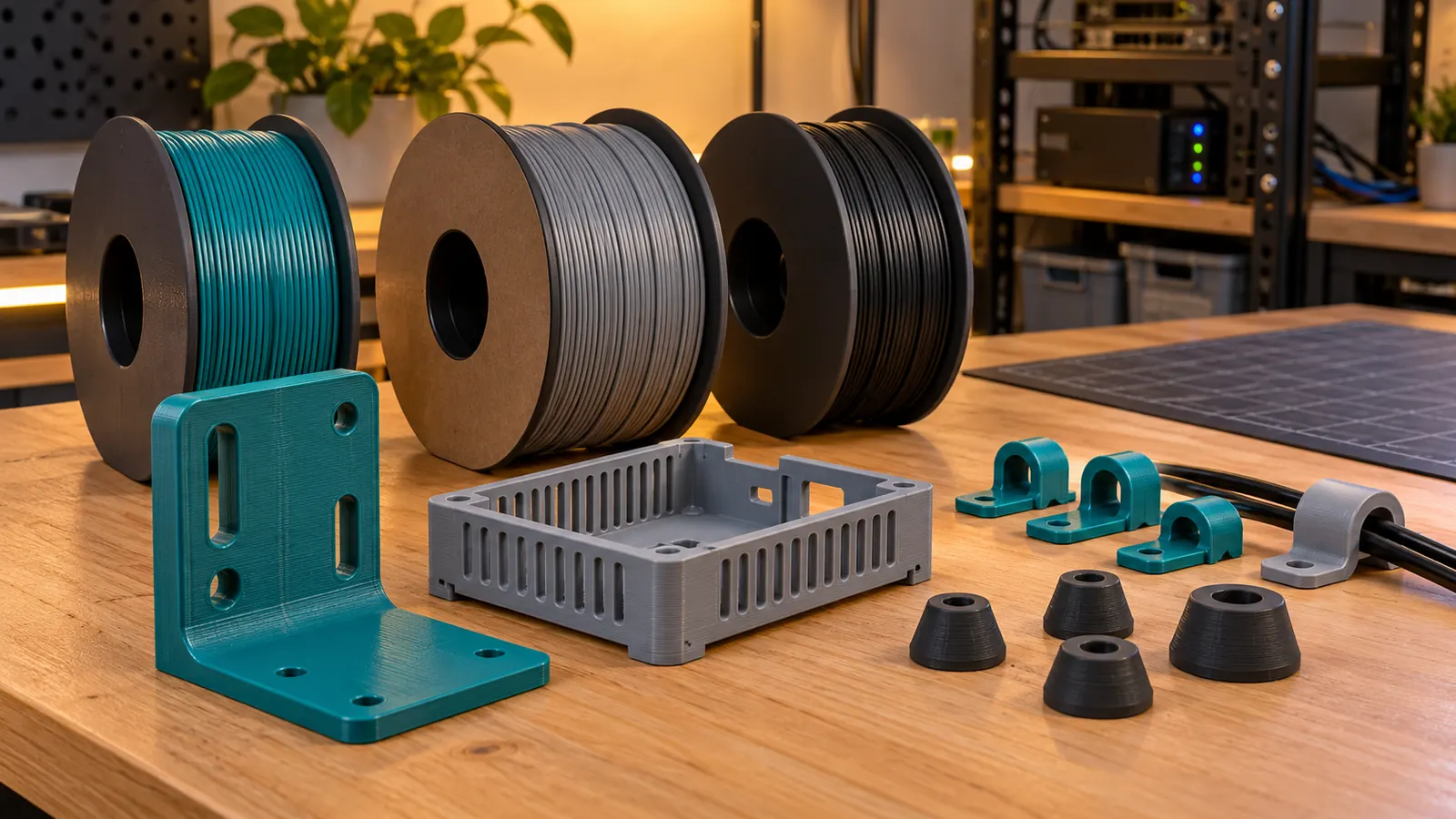
A cable clip and an outdoor radio case have very different jobs. Buy the spool for the part, not the colour of the rack. PETG is the useful starting point for everyday mounts, PLA makes tidy cool-room panels and prototypes, ASA handles exposed outdoor parts, and TPU gives you feet that bend instead of brackets that sag.
Material facts from maker datasheets, checked October 30, 2026.
Quick picks: four spools, four jobs
We earn a commission if you buy through our links — it doesn’t change our picks. How we make money → As an Amazon Associate I earn from qualifying purchases.
- Everyday mounts: Polymaker PETG Black, 1.75 mm / 1 kg. Start here for Pi cradles, light SSD mounts and cable clips.
- Cool indoor parts: Panchroma Basic PLA Black, 1.75 mm / 1 kg. Choose it for blanking panels, label holders and checking a bracket’s shape before the final material.
- Sun and warmer jobs: Polymaker ASA Black PF01001, 1.75 mm / 1 kg. Choose it for exposed radio mounts and outdoor cases, with an enclosed printer and ventilation.
- Flexible contact parts: PolyFlex TPU95 Black PD01001, 1.75 mm / 0.75 kg. Use it for feet, bumpers and soft cable-contact pieces.
If you’re still choosing the machine, our 3D printer picks for a homelab tinkerer separate open-frame PLA/PETG projects from enclosed ASA work. The 3D printing hub brings the materials, machines and projects together.
What are you making?
| Part | Start with | Why it fits |
|---|---|---|
| Cool indoor blanking panel or label holder | PLA | A rigid, tidy part with an easy first printing workflow |
| Pi cradle or light SSD mount | PETG | A practical mechanical-part material; leave vents and connector access open |
| Light rack ears/brackets near warm gear | PETG, or ASA when the temperature calls for it | Choose around the part’s actual heat and load; use metal for heavy equipment |
| Outdoor Meshtastic case or exposed mount | ASA | Maker-stated UV and weather resistance |
| Cable comb or clip | PETG | A useful mechanical fit for holders and clamps |
| Feet, bumpers or a soft cable-contact insert | TPU95 | Flexibility is the point; it isn’t a rigid shelf material |
Our printed homelab parts guide covers panels, shelves and fasteners. Keep the structural rack and shelves under a heavy NAS or UPS metal; save the printer for the organizers, adapters and light-duty parts around them.
Read the heat numbers before picking the bracket
HDT, Tg and Vicat are different tests. HDT measures deflection under the stated test load; Tg describes a material transition; Vicat measures softening under a specified penetration test. Use them to compare the documented materials, then leave temperature margin for a loaded part.
These are the current maker sheets linked from the product pages, not generic numbers for every spool bearing the same plastic name.
| Selected material and TDS | Glass transition, Tg | HDT at 0.45 MPa | HDT at 1.8 MPa | Other published property |
|---|---|---|---|---|
| Panchroma Basic PLA, V2.1 | Not listed | Not listed | Not listed | Vicat 62°C, ISO 306 |
| Polymaker PETG, V3.0 | 71.24°C | 69°C | 65°C | Vicat 75°C |
| Polymaker ASA, V6.0 | 98°C | 103°C | 100°C | Vicat 105°C; UV resistance stated |
| PolyFlex TPU95, V5.4 | Not listed | Not listed | Not listed | Shore hardness 95A |
PETG and ASA HDT values use ISO 75; their Tg values use DSC at 10°C/min. The TPU hardness test is ISO 7619-1 / GB/T 531.1. The selected sheets publish no numeric UV exposure-life rating, so the outdoor choice rests on ASA’s stated UV/weather resistance, not an invented number of sunny years.
Don’t turn the PLA’s 62°C Vicat value into a Tg or HDT number. It’s a different column for a reason. Likewise, keep PETG’s two HDT loads separate: a number at 0.45 MPa doesn’t describe the 1.8 MPa test.
PLA: the tidy indoor starting point
PLA is a good way to turn a sketch into a part you can hold. Use Panchroma Basic for a cool indoor label holder, blanking panel or first-fit prototype. Check that the screw holes line up and that the cable actually clears the lid before spending time on the final version.
For a bracket close to a warm exhaust, move the material decision ahead of the colour decision. Start with PETG or ASA according to the heat and load, and keep a rigid PLA mock-up as the fit reference. The maker’s Basic datasheet is the source for this spool; a different PLA blend can have different properties.
PETG: buy this for the everyday mount
A Pi cradle, a light SSD bracket and a row of cable clips are the kind of useful jobs that make PETG worth keeping on the shelf. Prusa’s PETG guidance names mechanical parts, holders and clamps as typical uses. Polymaker’s current PETG sheet says an enclosure isn’t needed.
Build the mount around the hardware’s airflow. Leave the Pi’s cooler inlet open, give the SSD room to shed heat and place a cable exit where it won’t pull on a connector. A case that looks beautifully solid in the slicer still needs holes in the right places.
The PETG table above is for Polymaker PETG V3.0, not the older PolyLite PETG formulation. Use the matching profile for the spool. For vent patterns and fasteners, follow the printed-parts guide instead of filling every opening with plastic.
ASA: take the project outside
Choose ASA for the exposed parts of an outdoor Meshtastic build: a shaded mounting bracket, an antenna support or a case designed for the board and battery. Its maker sheet explicitly describes improved weather resistance and UV resistance, alongside the higher heat-deflection figures in the table.
An outdoor case also needs a plan for water, seals and cable exits. Our 3D-printed Meshtastic case guide keeps the solar relay in a commercial IP-rated box and puts the printed tray inside. That’s a useful split: buy the weather shell and print the internal fit.
ASA needs an enclosure and ventilation. ABS belongs in that setup discussion too. Our printer enclosure, fumes and power guide covers where the printer goes and how to handle the air. Pick an enclosed machine for this job; don’t enclose an A1 to make it an ASA printer.
TPU: make the bit that should bend
Feet and bumpers have a different brief from a shelf: you want compliance at the contact point. PolyFlex TPU95 is the flexible pick here, with a maker-published Shore hardness of 95A. Print the soft insert separately and let a rigid PETG or ASA part carry the shape around it.
Polymaker recommends a direct-drive extruder, with the drive close to the hotend. A long unsupported feed path makes soft filament harder to handle. Start with the maker’s profile and a small foot or bumper rather than a whole plate of elaborate supports.
What the spool needs from the printer
Plain material and a fibre-filled blend are different purchases. The four picks here are unfilled. Don’t add a hardened nozzle to every shopping list simply because the label says ASA or PETG.
For a specific example, Polymaker’s Fiberon ASA-CF08 datasheet recommends a wear-resistant nozzle, such as hardened steel or ruby, because the blend abrades brass. That instruction belongs to that CF blend, not automatically to the plain ASA spool above.
Then deal with moisture. Keep open rolls protected, use the exact filament maker’s drying instructions and feed moisture-sensitive material from dry storage where appropriate. Our filament drying and storage guide separates a heated dryer from a storage-only box, so you buy the tool that solves the problem. Polymaker specifically recommends dry storage for its PETG; give flexible TPU the same attention before chasing settings.
From spool to a useful part
- Name the job. Is this a panel, a light mount, an outdoor shell or a flexible contact piece?
- Choose the material around heat and sunlight. Use the specific TDS, not a generic melting-point chart.
- Design the fit. Keep airflow, plug access, screw clearance and antenna exits in the model.
- Print a small fit piece first. A corner with the mounting holes can settle the dimensions before a full enclosure.
- Try it where it will live. Inspect the part under its real load after the equipment warms up; change a softening or deforming part before relying on it.
Start with PETG for most useful mounts. Keep PLA for cool indoor parts, ASA for exposed outdoor work and TPU for the pieces that should flex. A spool chosen for the job is more useful than four impressive material names on the shelf.
Sources & methodology
Where these facts come from.
- Panchroma Basic PLA — product datasheet V2.1 · checked October 30, 2026
- Polymaker PETG — technical datasheet V3.0 · checked October 30, 2026
- Polymaker ASA — technical datasheet V6.0 · checked October 30, 2026
- PolyFlex TPU95 — technical datasheet V5.4 · checked October 30, 2026
- Polymaker — PolyFlex TPU95 direct-drive guidance · checked October 30, 2026
- Fiberon ASA-CF08 — wear-resistant nozzle guidance · checked October 30, 2026
- Prusa — material and printer-hardware guide · checked October 30, 2026
- Prusa — PETG mechanical-part uses · checked October 30, 2026
Source dates are listed above.
As an Amazon Associate I earn from qualifying purchases.
Parts from this article
The gear, on Amazon
The models recommended above, with the specifications that matter for your choice.
First spool
Polymaker Panchroma Basic PLA, black 1 kg
Print your first cable guides and organizers with a straightforward PLA spool.
Functional parts spool
Polymaker PETG, black 1 kg
Move to PETG when your project calls for tougher functional parts.
For sun and warmer parts
Polymaker ASA Black 1.75 mm 1 kg (PF01001)
Choose ASA for outdoor cases and warmer functional parts on an enclosed printer.
For feet and bumpers
Polymaker PolyFlex TPU95 Black 1.75 mm 0.75 kg (PD01001)
Choose flexible 95A TPU for feet, bumpers and soft cable-contact parts.
Prepared by Racks & Watts.