SDR
RTL-SDR starter kit and antennas: what to buy for planes, weather sensors and scanning
Choose an RTL-SDR receiver, dipole or dedicated antenna for aircraft, 433/915 MHz sensors and scanning. Match the band, cable and SMA connector.
OUR PICKS / YOUR SETUP
Find your fit.
Choose the RTL-SDR Blog V3 dipole kit for exploration or Nooelec NESDR SMArt v5 bundle for 433 MHz sensors. Add AirNav for aircraft, muzi works for 915 MHz or Diamond D130J for fixed scanning; use Nooelec pigtails when the feed line needs an adapter.
- ExploreV3 + dipole
- Sensors433 / 915 MHz
- Aircraft1090 MHz
We earn a commission if you buy through our links — it doesn’t change our picks. How we make money → As an Amazon Associate I earn from qualifying purchases.
YOUR NEXT PROJECT / THE GEAR
Parts list
- RTL-SDR Blog V3 with dipole antenna kitCheck price on Amazon
R860 tuner, 1 PPM TCXO and a dipole kit with mounts for better antenna placement.
- Nooelec NESDR SMArt v5 bundleCheck price on Amazon
0.5 PPM TCXO and SMA input in an aluminium enclosure with a heatsink.
- AirNav 1090 MHz outdoor ADS-B antenna (ANTADSBEXTSMA)Check price on Amazon
A dedicated vertical aircraft antenna with a mounting bracket and 30-foot SMA coax lead included.
- muzi works 915 MHz whip antenna, 17 cmCheck price on Amazon
Add a flexible 915 MHz whip to a receiver or radio node with a matching SMA connector.
- Diamond D130J discone antennaCheck price on Amazon
Explore multiple receive bands with a fixed-mount discone and a feed line suited to your receiver.
- Nooelec SMA Cable Connectivity Kit (100770)Check price on Amazon
Connect a different antenna feed line to an SMA receiver with a short, flexible adapter cable.
The fun starts when the antenna matches the job. A USB radio and an adjustable dipole give you room to explore; a dedicated antenna makes sense when you decide to keep watching aircraft or collecting sensor readings. Buy that first signal path, then add the next band.
Specs and setup guidance come from the makers and project docs, checked October 31, 2026.
For FM overload or a filtered aircraft amplifier, the filters and LNAs guide explains what goes between the antenna and receiver.
Pick the kit for your first project
Start with the RTL-SDR Blog V3 dipole kit if you want to try several bands. Its R860 tuner, female SMA input and included mounts make it a useful radio to move between projects. Choose the Nooelec NESDR SMArt v5 bundle if you want a compact receiver with a 433 MHz mast in the box. Buy one receiver to start, not both.
For a fixed aircraft receiver, add the AirNav 1090 MHz outdoor antenna. For a supported 915 MHz sensor, use the muzi works 915 MHz whip. Choose the Diamond D130J discone for a permanent, broad-band scanning installation, and the Nooelec 100770 cable kit when your feed line needs a different connector.
This guide is receive-only: follow the rules for receiving signals where you live.
Which antenna for which band?
| Job | Antenna pick | Maker-stated band or examples | Connection and cable |
|---|---|---|---|
| Explore VHF and UHF | RTL-SDR Blog V3 kit dipole | Long elements cover VHF–UHF; maker examples include roughly 70 and 162 MHz | SMA male; 60 cm base lead plus 3 m RG174 extension |
| Collect 433 MHz sensor bursts | Nooelec v5 bundle’s fixed 433 MHz mast | 433 MHz ISM mast | Included SMA base with 2 m RG58 lead |
| Collect supported 915 MHz sensor bursts | muzi works 17 cm whip, 915 MHz version | 915 MHz | SMA male; attaches to receiver’s female SMA |
| Watch aircraft | AirNav ANTADSBEXTSMA | 1090 MHz ADS-B | Included 30 ft coax with SMA connector and mounting bracket |
| Scan several receive bands from a fixed mount | Diamond D130J | 25–1300 MHz | UHF connector; separate feed line required |
Match the signal, decoder and antenna as a set. RTL-SDR’s dipole guide, Nooelec’s bundle contents, muzi’s whip options, AirNav’s antenna specification and Diamond’s catalog supply the table.
The flexible starter: RTL-SDR Blog V3 and its dipole
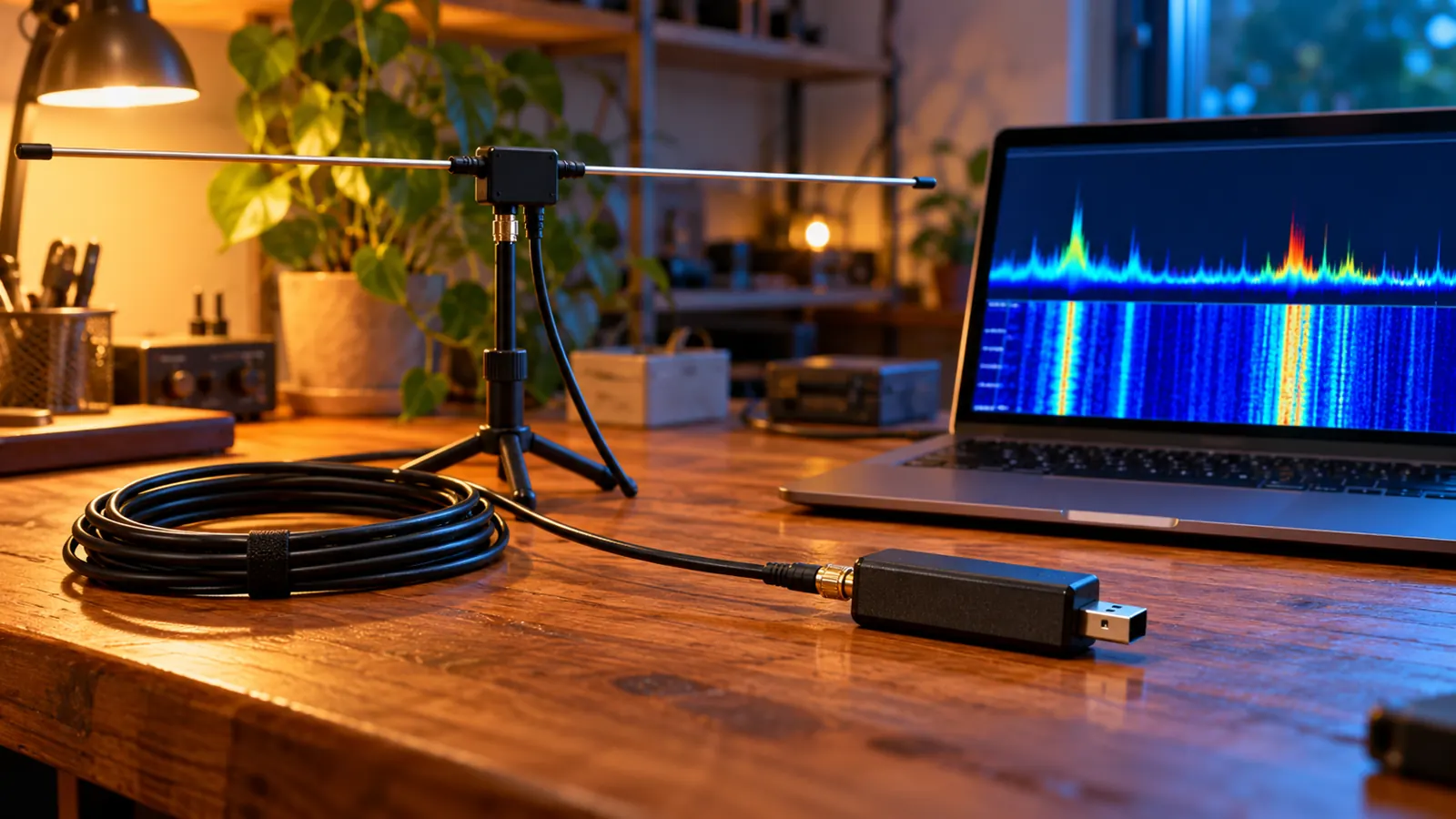
The V3 kit earns its place through the bits around the receiver. You get two long telescopic elements, two short ones, a dipole base, a flexible tripod, a suction mount and the extension cable. That gives you somewhere to put the antenna besides directly behind a noisy computer. The maker’s kit list identifies the receiver as R860/R820T2 with a 1 PPM temperature-compensated oscillator.
Extend both elements equally. Use the long pair for VHF exploration and the short pair for UHF; the maker also documents the short pair for 1090 MHz reception. For vertically polarized terrestrial signals, stand the dipole vertically. Keep this portable kit sheltered; choose an outdoor antenna for a permanent mount. Dipole setup and placement
V3 vs V4: the tuner change that matters
The Blog V4 uses an R828D, while the V3 uses an R860/R820T2. The V4 adds built-in HF upconversion and separates its input filtering into HF, VHF and UHF bands. That is the meaningful distinction if HF listening is part of your plan. Use software with the updated V4 driver; the maker documents incorrect or missing reception with the wrong driver. V4 hardware changes · V4 driver guide
Sensors: Nooelec for 433 MHz, a matching whip for 915 MHz
The NESDR SMArt v5 bundle combines an RTL2832U and R820T2/R860 tuner with a 0.5 PPM oscillator, aluminium enclosure and heatsink. Its antenna base has a 2 m RG58 lead; the three masts include a telescopic antenna, a fixed UHF antenna and a fixed 433 MHz antenna. That last one makes this bundle a tidy starting point for supported 433 MHz weather sensors. Nooelec receiver and bundle specification
Already own the V3 dipole kit? Start there rather than buying another receiver just for its antenna. Our rtl_433 weather-sensor guide walks through matching the sensor model and decoder.
For a supported 915 MHz sensor, the muzi works MM-WHIPANT-915 is a separate, 17 cm SMA-male whip. Choose that frequency version; the maker also sells an 868 MHz version. A matching connector gets it attached, while the matching band gets it ready for the job. muzi works whip specifications
Before buying a sensor antenna, find the exact sensor in the rtl_433 project’s supported-device list. An antenna cannot add a missing decoder.
Aircraft: give 1090 MHz its own antenna
The AirNav ANTADSBEXTSMA is the straightforward fixed-build pick: a 66 cm vertical antenna for 1090 MHz, supplied with a mounting bracket and 30 ft coax lead ending in SMA. That included lead keeps the first shopping list simple. Put it where it has a clear view rather than hiding it behind the host. AirNav antenna and included cable
Use our Pi 5 ADS-B receiver build for the complete host, readsb and tar1090 setup. The dipole kit can then move to another project instead of being tied to aircraft duty.
Scanning: Diamond D130J for a permanent antenna
The Diamond D130J covers 25–1300 MHz for reception. A discone makes sense when you want to explore several bands from one fixed mount instead of changing a small antenna each time. Its size and mounting needs make it a different purchase from a desk whip. Diamond D130J specifications
The D130J has a UHF connector; the D130NJ is the N-connector variant. Buy the feed line for the exact model. Diamond’s assembly manual says coax is not included, so allow for the mount, cable route and receiver-end adapter together.
Adapters: make the ends meet
All three receiver paths discussed here—Blog V3, Blog V4 and Nooelec v5—use SMA inputs. SMA and RP-SMA are different: look at the centre contact as well as the thread. The Nooelec 100770 kit supplies eight short, 15 cm RG58 pigtails with SMA-male receiver ends and several far-end connectors. Nooelec cable kit and connector guide
For the D130J, plan this path: antenna UHF/SO-239 socket → feed line with PL-259 plugs → kit’s SO-239-to-SMA pigtail → receiver. The pigtail’s female SO-239 end mates with a PL-259 plug; it does not join directly to another female socket. These short adapters bridge connector types, not the distance to the roof.
The V3 dipole, Nooelec antenna base and AirNav SMA cable already fit their receivers without this adapter kit. Add it when your chosen feed line needs it.
Get your first useful signal
- Choose one job. Aircraft means 1090 MHz and the ADS-B guide; weather sensors mean the sensor’s actual band and a supported rtl_433 decoder; scanning starts with the service’s receive frequency.
- Connect the antenna and place it away from the computer. Use the dipole mounts and extension to try a window or a clearer position.
- Install the receiver’s matching driver and software. Follow the RTL-SDR quick-start guide; use the V4-specific driver when applicable.
- Leave bias-tee power off for these passive antennas. The V3 guide explains that setting; it is power sent along the coax for accessories that need it.
- Change one thing at a time. Keep the same frequency and decoder while you compare antenna positions. Look for stable decoding or a clearer signal before adding more hardware.
Start with the V3 dipole kit for exploration or Nooelec v5 bundle for a 433 MHz sensor project. Add AirNav for a fixed aircraft build, muzi’s 915 MHz whip for that sensor band, or the D130J for fixed scanning. More projects are waiting in the SDR lab.
Sources & methodology
Where these facts come from.
- RTL-SDR Blog V3 tuner, SMA connector and dipole-kit contents · checked October 31, 2026
- RTL-SDR Blog V4 R828D and built-in HF upconversion · checked October 31, 2026
- RTL-SDR Blog V4 driver requirements · checked October 31, 2026
- RTL-SDR Blog dipole element sizes, frequency examples, placement and portable use · checked October 31, 2026
- Nooelec NESDR SMArt v5 bundle tuner, supplied 433 MHz antenna and coax · checked October 31, 2026
- muzi works 17cm whip: 915 MHz variant and SMA male · checked October 31, 2026
- AirNav 1090 MHz vertical with mounting bracket and 30ft SMA coax · checked October 31, 2026
- Diamond maker catalog: D130J 25–1300 MHz discone and UHF connector · checked October 31, 2026
- Nooelec 100770 eight RG58 SMA adapter cables and connector genders · checked October 31, 2026
- RTL-SDR Blog receiver setup and driver/software first check · checked October 31, 2026
- rtl_433 supported devices, bands and receiver configuration · checked October 31, 2026
- RTL-SDR Blog V3 direct sampling and bias-tee guidance · checked October 31, 2026
- Diamond D130J assembly and separate coax requirement · checked October 31, 2026
Source dates are listed above.
As an Amazon Associate I earn from qualifying purchases.
YOUR NEXT PROJECT / THE GEAR
Parts list
- RTL-SDR Blog V3 with dipole antenna kitCheck price on Amazon
R860 tuner, 1 PPM TCXO and a dipole kit with mounts for better antenna placement.
- Nooelec NESDR SMArt v5 bundleCheck price on Amazon
0.5 PPM TCXO and SMA input in an aluminium enclosure with a heatsink.
- AirNav 1090 MHz outdoor ADS-B antenna (ANTADSBEXTSMA)Check price on Amazon
A dedicated vertical aircraft antenna with a mounting bracket and 30-foot SMA coax lead included.
- muzi works 915 MHz whip antenna, 17 cmCheck price on Amazon
Add a flexible 915 MHz whip to a receiver or radio node with a matching SMA connector.
- Diamond D130J discone antennaCheck price on Amazon
Explore multiple receive bands with a fixed-mount discone and a feed line suited to your receiver.
- Nooelec SMA Cable Connectivity Kit (100770)Check price on Amazon
Connect a different antenna feed line to an SMA receiver with a short, flexible adapter cable.
Prepared by Racks & Watts.