Local AI server
Two-GPU Ollama box on a B450 board: RTX 3060 Ti + RTX 2060, 48 GB, measured
The recorded two-GPU B450 test bench: annotated slot mapping, per-card model residency and power caps, with explicit limits on split-run and slot-width conclusions.
Read the recorded slot map before copying the build.
3060 Ti: x4 slot label8 GB, with a recorded 150 W software cap.
2060: x16 slot label6 GB, with a recorded 125 W software cap.
Separate the observationsSlot labels do not establish clearance or a lane-width speedup.
Your plan, at a glance.
THE LAB BRIEF
The short answer.
Use the recorded build as an assembly and workload reference. The notes place the 3060 Ti in the x4-labelled slot and the 2060 in the x16-labelled slot; no slot-swap or clearance test establishes an ideal placement.
- 3060 Ti slot recordPCIe x4 label
- 2060 slot recordPCIe x16 label
- qwen fully resident75.8 / 57.7 tok/s
Readers evaluating the recorded two-card configuration and named model workloads, with a separate check of their own physical and software requirements.
A guaranteed fit, slot recommendation, new-card benchmark or current-price shopping list; those are not established by these notes.
Parts list
What is in the box
| Part | Model |
|---|---|
| CPU | AMD Ryzen 5 5600G (6C/12T, integrated graphics) |
| Motherboard | Gigabyte B450M DS3H V2 (firmware F62b) Initial note: 3060 Ti in x4-labelled slot; 2060 in x16-labelled slot. No negotiated-width or slot-swap measurement. |
| GPU, x4 slot record | NVIDIA GeForce RTX 3060 Ti 8 GB 150 W software cap; initial recorded configuration |
| GPU, x16 slot record | NVIDIA GeForce RTX 2060 6 GB 125 W software cap; initial recorded configuration |
| Memory | 2 x 8 GB Corsair CMK16GX4M2B3200C16 + 2 x 16 GB Samsung-labelled 16GXMP3200CL16 = 48 GB @ 3200 |
| Storage | WD Blue SN570 500 GB NVMe |
Check current prices on Amazon; hardware specifications are from the makers’ sources. Links marked on Amazon are affiliate links.
Measured on our bench
The numbers
Measured September 25–26, 2026. Method on the bench notes.
The useful part of this two-GPU build is its recorded configuration and the workloads that were actually observed. The September bench notes identify a Gigabyte B450M DS3H V2 with firmware F62b, a Ryzen 5 5600G and mixed memory totalling 48 GB. The two cards are an RTX 3060 Ti 8 GB and an RTX 2060 6 GB.
Measurements below remain dated September 25, 2026; the platform inventory was recorded on September 26. This page adds no new hardware test, current price or whole-system power measurement.
Annotated map of the recorded slot assignment
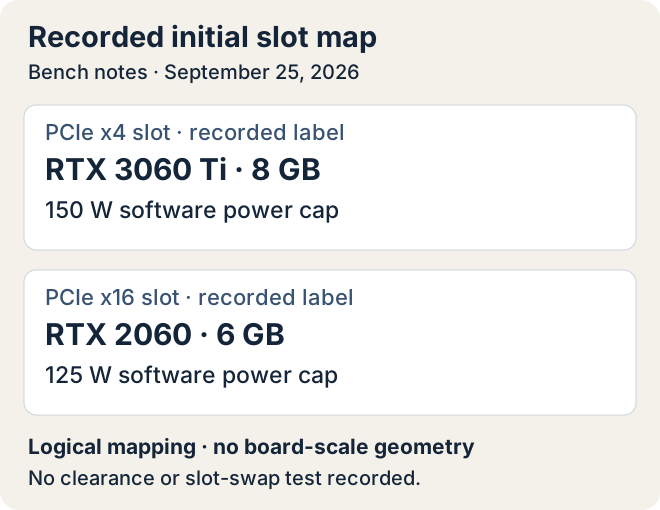
The diagram reproduces the Bench under test record: 3060 Ti in the x4-labelled slot; 2060 in the x16-labelled slot. It does not depict physical slot order, board dimensions, cable routing or clearance. The labels also do not establish negotiated lane widths. The later card-vs-card section does not separately re-document slot placement, so no per-row slot assignment is inferred from this initial configuration.
There is no same-card x4-versus-x16 experiment in the record. Do not use the card-speed difference below to estimate a slot penalty or choose an ideal placement. Before copying the parts, check the exact board, card dimensions, cooling and supported slot arrangement for the proposed assembly.
Keep the per-card workload record beside the parts list
The later session used one card at a time with nothing else loaded on either GPU: Ollama 0.34, Q4_K_M models, flash attention and q8_0 KV cache. After a warm-up, each row used three 512-token generation runs with seed 1 and temperature 0. Speed is the mean of those runs; GPU draw is the mean of runs two and three. The output length is not a statement of the configured context-window size.
| Model | RTX 3060 Ti, 150 W cap | RTX 2060, 125 W cap | What the row compares |
|---|---|---|---|
| qwen2.5:7b | 75.8 tok/s, 100% on GPU | 57.7 tok/s, 100% on GPU | Fully resident per-card configurations |
| llama3.1:8b | 73.6 tok/s, 100% on GPU | 44.8 tok/s, 86% on GPU | Different residency; CPU participates on the 2060 |
| qwen2.5:14b | 14.5 tok/s, 71% on GPU | 8.6 tok/s, 48% on GPU | Both configurations include CPU offload |
These percentages are Ollama’s reported model placement, not GPU utilisation readings. The llama and 14B rows do not isolate GPU hardware performance. The card comparison separates these interpretation boundaries in more detail.
Preserve the measured power-cap context
For the fully resident qwen2.5:7b runs, the 3060 Ti recorded 75.8 tok/s at a 150 W cap versus 77.9 tok/s at a 200 W cap. The 2060 recorded 57.7 tok/s at 125 W versus 59.1 tok/s at 170 W. Rounded, those capped results retained 97% and 98% of the respective stock-cap speeds.
Recorded GPU draw fell from 191.9 W to 144.2 W on the Ti, a 47.7 W difference, and from 165.6 W to 121.5 W on the 2060, a 44.1 W difference. These are driver readings for those runs. They do not establish total outlet power, PSU sizing or the result for a different card.
For the missing capacity and cable checks, use the two-GPU PSU selection guide. It now compares verified MSI, Seasonic and Corsair buying options against worked budgets and independent cable runs; these runtime GPU readings remain separate from PSU sizing.
Keep GPU identification and supported power range beside any cap setting. An ordinal GPU index is not a permanent hardware identity. No new power-limit or startup configuration is claimed here.
Treat the earlier two-GPU split as a separate observation
The notes report qwen2.5:14b fully in VRAM across both GPUs at about 38 tok/s earlier that week. They do not give that observation the later three-run protocol. The initial single-request dataset also includes a partly occupied 2060 and a CPU-spilling result; it is a different test condition.
Do not calculate a controlled split-versus-solo speedup from those unmatched runs or assume adding advertised memory capacities proves that another workload will fit. Confirm allocation and runtime behaviour on the intended model, settings and available memory.
Check the platform evidence before copying the assembly
The recorded memory was two 8 GB Corsair DIMMs plus two 16 GB Samsung-labelled DIMMs, totalling 48 GB, reported at 3200 MT/s. The notes contain no memory-error log entries during 3 days 13 hours of uptime under GPU and LLM load. That observation does not replace a dedicated memory test or guarantee another mixed kit.
Use the parts list as a record, then verify missing physical information for the proposed assembly: card thickness and length, slot access, cooling clearance and required power connections. Those dimensions are not supplied by the logical diagram. Keep model-loading and sustained-workload checks separate from a successful hardware boot.
Keep replacement candidates separate from tested parts
A 12 GB RTX 3060 variant is an untested capacity candidate, supported here only by its manufacturer specification. We have no measurement of its model residency, throughput or installed behaviour in this build, and no current price ranking.
For a budget based on outlet energy, use the monthly homelab electricity-cost guide. The GPU readings here do not establish a whole-system monthly cost. A useful copy of this build starts with the recorded parts and closes the unmeasured fit, power and workload gaps explicitly.
The recorded SSD is a configuration detail, not an SSD benchmark. If you are considering buying that model, the NVMe boot-drive comparison covers checked alternative offers, documented fit and capacity trade-offs.
For a new enclosure, the two-GPU case guide compares rear-slot space, motherboard spacing, card clearance and cable access before you assemble the pair.
Common questions
Quick answers.
Which card was recorded in each slot?
The Bench under test section records the 3060 Ti in the PCIe x4 slot and the 2060 in the PCIe x16 slot. Those are the note’s slot descriptions, not negotiated lane-width measurements.
Did you compare the same card in both slots?
No. There is no slot-swap experiment or clearance measurement. The later per-card session does not separately document slot assignments.
Was the earlier 14B split a matched benchmark?
No. The notes report about 38 tok/s across both GPUs in an earlier observation without the later three-run protocol. It should not be used as a controlled speedup over a solo-card row.
Was the mixed RAM independently stress-tested?
The recorded 48 GB configuration reported 3200 MT/s and no memory-error log entries during 3 days 13 hours of uptime. That is not a dedicated memory-test result or a guarantee for another kit.
Sources & methodology
Where these facts come from.
- Dated test-bench configuration and measurement protocols · checked October 19, 2026
- NVIDIA — RTX 3060 memory variants, untested candidate · checked October 19, 2026
Source dates are listed above.
Prepared by Racks & Watts.